

Attendance Percentage Calculator
Enter your total classes and the classes you’ve attended, and this calculator instantly tells you your attendance percentage, whether you meet the 75% requirement most colleges use, and exactly how many classes you can afford to miss or need to attend to get back on track.
If you just need the number, use the calculator above. If you want to understand how it’s calculated, what the 75% rule actually means for you, or what to do if you’re falling short, keep reading.
How to use this attendance calculator
- Enter the total number of classes held so far (for the subject, semester, or term you’re checking).
- Enter the number of classes you attended out of that total.
- If your institution uses a different minimum (some use 80% or 85% instead of 75%), enter that in the minimum requirement field. Otherwise leave it at the default 75%.
- Click calculate. You’ll instantly see your current percentage, whether you’re above or below the requirement, and how many classes you can miss or must attend to fix it.
How attendance percentage is calculated
The formula is simple:
Attendance Percentage = (Classes Attended ÷ Total Classes) × 100
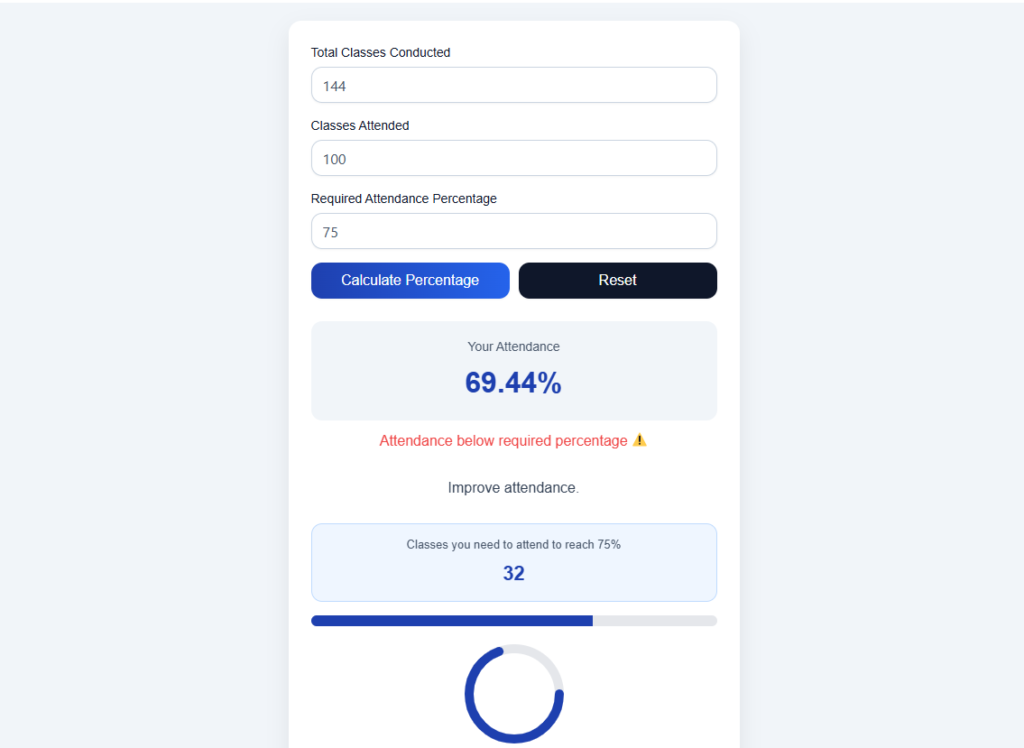
Worked example: say your college has held 144 classes so far this semester, and you’ve attended 100 of them.
100 ÷ 144 = 0.694 0.694 × 100 = 69.4% attendance
That’s below the common 75% requirement, so this student is currently short. The calculator also works out exactly what to do about that — which brings us to the part most attendance calculators skip.
What the 75% attendance rule actually means
Most Indian colleges and universities set a minimum attendance requirement — usually 75%, though some departments or institutions require 80% or even 85% — as a condition for sitting your semester exams. Fall below it, and you can lose exam eligibility entirely, or be asked to file for a condonation/exemption that isn’t guaranteed.
This isn’t unique to one university; it’s a standard academic policy used across engineering colleges, arts and science colleges, and many school boards. The exact number and the exception process (medical certificates, official leave, etc.) vary by institution, so always check your own college’s attendance policy alongside using this tool — think of the calculator as the fast way to check where you stand, not a substitute for your institution’s official rule.
How many classes can I miss and still stay at 75%?
This is usually the real question behind “attendance calculator” searches — not just “what’s my percentage” but “how much room do I have.” The calculator answers both, but here’s the logic so you understand what it’s showing you:
If you’re already above 75%: the calculator works out how many upcoming classes you can skip while your percentage stays at or above 75%. The more classes remain in the term, the more room you generally have — but that room shrinks fast near the end of a semester, so don’t treat an early “you can miss 12 classes” result as fixed for the whole term.
If you’re below 75%: the calculator instead shows how many classes in a row you need to attend to climb back to 75%, assuming no further absences. This number rises quickly once you’re behind, which is exactly why checking your attendance every few weeks — not just before exams — matters.
Worked example: with 100 out of 144 classes attended (69.4%), if 20 more classes remain in the semester, attending all 20 would bring the total to 120 out of 164 — that’s 73.2%, still short of 75%. This is the kind of gap a lot of students don’t realize until it’s too late to fix, which is exactly why checking early changes the outcome.
Quick reference: how many classes you need for 75%
If you want a rough number before running the exact calculation, here’s what 75% looks like across common class totals used in Indian semesters:
| Total Classes | Classes Needed for 75% | Classes You Can Miss (if attending all) |
|---|---|---|
| 60 | 45 | 15 |
| 90 | 68 | 22 |
| 100 | 75 | 25 |
| 120 | 90 | 30 |
| 144 | 108 | 36 |
| 160 | 120 | 40 |
| 180 | 135 | 45 |
These are starting-point numbers assuming no classes have been missed yet. Once you’ve already attended some and missed others, the exact number you can still miss (or need to attend) changes — that’s what the calculator above works out for your specific numbers, since the math isn’t linear once you’re partway through the term.
Why attendance percentage matters beyond exam eligibility
- Exam eligibility is the most immediate consequence — most institutions won’t let you sit end-semester exams below the minimum.
- Internal assessment marks at many colleges factor in attendance directly, so shortage can cost you marks even if you clear the eligibility bar.
- Condonation and appeals are usually possible but require documentation, aren’t guaranteed, and take time you could avoid spending by tracking attendance proactively.
- Habit and outcomes — students who track attendance regularly tend to catch shortfalls while they’re still easy to fix, rather than discovering a problem with two weeks left in the semester.
Tracking attendance by subject, not just overall
Overall attendance is useful, but most attendance rules are actually applied per subject, not as one combined number across your whole course load. It’s common to be comfortably above 75% overall while sitting well below it in one specific subject you’ve been skipping — and that single subject can still block your exam eligibility for that paper. If you’re managing multiple subjects with different attendance patterns, use the Subject Wise Attendance Calculator to check each one individually rather than relying on a single blended percentage that can hide a subject-specific shortfall.
If you’ve already missed a lot of classes
If you’re trying to work out how many more classes you can afford to skip from here without dropping below your requirement — rather than starting from a shortage you’re recovering from — the Bunk Calculator is built specifically for that. It takes your current standing and tells you your safe margin going forward, which is a slightly different question from “am I currently short,” and worth checking separately if you’re planning ahead rather than catching up.
Common mistakes students make when tracking attendance
Calculating from memory instead of actual records. It’s easy to underestimate how many classes you’ve skipped, especially across multiple subjects. A quick calculation with real numbers is far more reliable than a mental estimate.
Checking only once, right before exams. By the time exam eligibility lists come out, it’s often too late to recover a shortfall. Checking every few weeks turns a crisis into a minor adjustment.
Treating overall attendance as the only number that matters. As covered above, a single subject can drag you below the requirement for that paper even if your combined percentage looks fine.
Assuming every college uses 75%. The percentage, the exception process, and how strictly it’s enforced all vary by institution and sometimes by department within the same college. Don’t assume your friend’s college rule applies to yours.
Not accounting for remaining classes. Your current percentage only tells you where you stand today. Whether you can recover — and how many classes that takes — depends on how many classes are left in the term, which is exactly why the calculator’s “classes needed” figure matters more than the raw percentage alone.
Tips to stay above the requirement
- Check every 2-3 weeks, not once before exams. Attendance problems are easy to fix early and hard to fix late.
- Set a personal target above the minimum — aiming for 80% instead of 75% gives you a buffer for the occasional unavoidable absence.
- Track subject-wise, especially for classes you’re tempted to skip. A subject you consistently under-attend can end up below the limit even while your overall number looks fine.
- Know your institution’s exception process before you need it. Medical certificates and official leave documentation are usually accepted, but the process and deadlines differ by college — check your own institution’s rule rather than assuming it works like every other college’s.
When to recalculate during the semester
Your attendance percentage isn’t a one-time number — it shifts every time a new class is held, whether you attend it or not. A percentage that looked safe in week 4 can look very different by week 10, especially if a few unavoidable absences stack up around exams, festivals, or illness. Recalculating at fixed points — after each internal assessment cycle, or roughly every two to three weeks — gives you an early warning instead of a late one.
This matters more early in a semester than it might seem. A shortfall of 5 classes in week 3, with 30 classes still remaining, is easy to recover from. The same shortfall in week 10, with only 8 classes left, might be mathematically impossible to fix. The number itself doesn’t change how urgent it is — the classes remaining do, which is why this calculator always factors in your specific numbers rather than giving you a generic percentage.
FAQ
How do I calculate my attendance percentage?
Divide the number of classes you attended by the total number of classes held, then multiply by 100. For example, 100 classes attended out of 144 total gives you 69.4% attendance. This calculator does that instantly and also shows what to do if you’re short.
How do I calculate attendance percentage in college?
The method is the same as any attendance calculation: divide classes attended by total classes held, then multiply by 100. In college specifically, this is usually tracked per subject rather than as one combined number, so check each subject separately if your attendance varies across them.
What does 75% attendance mean in days?
It depends on your total number of classes or working days in that period, not a fixed day count. For a 30-day month, 75% means attending 23 out of 30 days. For 144 total classes in a semester, 75% means attending at least 108 of them.
What happens if my attendance is below 75%?
Most institutions restrict exam eligibility below the minimum requirement, though many also have a condonation or exemption process for genuine reasons like medical emergencies. Check your specific college’s attendance policy, since the process and acceptable exceptions vary by institution.
Can I still pass if I’m below 75% attendance?
Some institutions allow appeals with valid documentation, such as medical certificates, but this isn’t guaranteed and depends entirely on your college’s specific policy. The safest approach is to avoid falling short in the first place by checking your attendance regularly.
Does attendance percentage affect my internal marks?
At many colleges, yes. Attendance is factored into internal assessment scoring separately from exam eligibility, meaning shortage can cost you marks even if you technically remain eligible to sit exams. This varies by institution.
Is 75% attendance the same rule everywhere?
No. 75% is the most common minimum across Indian colleges and universities, but some departments or institutions require 80% or 85% instead. Always confirm your specific institution’s requirement.
How often should I check my attendance percentage?
Every two to three weeks is a reasonable habit for most students, and more frequently if you already know you’re close to the limit. Checking regularly turns attendance into something you manage proactively instead of a surprise at exam time.
Can I recover from a low attendance percentage?
Yes, as long as enough classes remain in the term. The earlier you check and start attending consistently, the fewer classes you need to recover.