

JEE Main Rank Predictor 2026 – Predict Your JEE Main Rank, Percentile, NIT & IIT Admission Chances Instantly
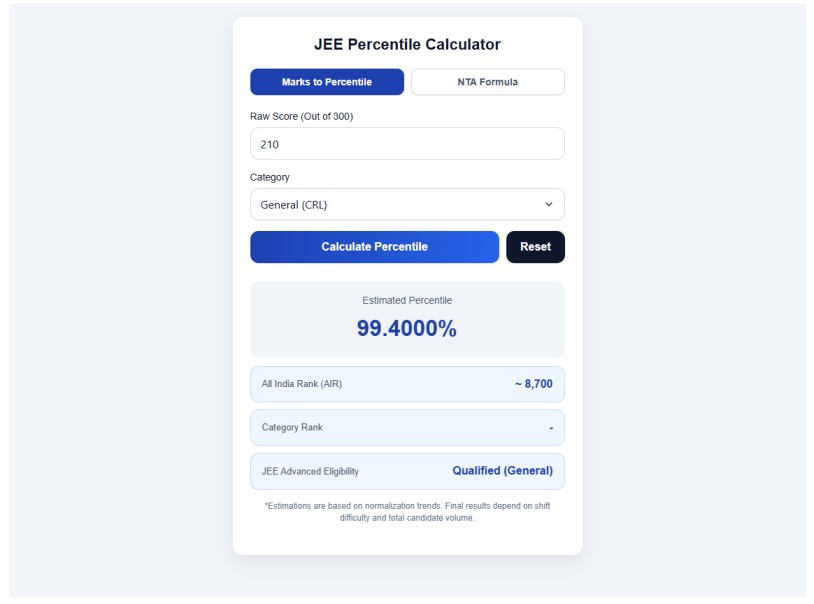
JEE Percentile Calculator
*Estimations are based on normalization trends. Final results depend on shift difficulty and total candidate volume.
Every year, more than 15 lakh students appear for the Joint Entrance Examination (JEE Main), hoping to secure admission to India’s top engineering colleges. After completing the exam, almost every student asks the same question:
“What will be my JEE Main Rank?”
Waiting for the official result can feel stressful, especially when you want to know whether your score is good enough for an NIT, IIIT, GFTI, or even eligibility for JEE Advanced.
That’s exactly why our JEE Main Rank Predictor is designed.
Instead of waiting for counselling to begin, you can use the calculator above to estimate your expected All India Rank (AIR) based on your JEE Main percentile. The prediction is based on previous year trends, NTA normalization patterns, candidate data, and historical admission statistics.
Whether you searched for Predict JEE Main Rank, JEE Mains Rank Predictor, JEE Main Percentile Predictor, or Rank Calculator JEE Mains, you’re in the right place.
Simply enter your expected percentile (or marks if your tool supports it), click Calculate, and instantly estimate:
- Expected JEE Main Rank (AIR)
- Percentile analysis
- JEE Advanced eligibility
- NIT admission chances
- IIIT admission chances
- Previous year comparison
Our calculator is completely free, mobile-friendly, and designed to help students make better admission decisions before JoSAA counselling begins.
What Is a JEE Main Rank Predictor?
A JEE Main Rank Predictor is an online tool that estimates your expected All India Rank (AIR) using your JEE Main percentile.
The National Testing Agency (NTA) does not prepare ranks directly from marks. Since JEE Main is conducted in multiple sessions, every paper has a slightly different difficulty level. To ensure fairness, NTA first converts marks into a normalized percentile.
After all exam sessions are completed, the percentile is used to prepare the Common Rank List (CRL).
Because of this process, students frequently search for:
- predict JEE Main rank
- JEE Main percentile predictor
- JEE Mains percentile predictor
- rank calculator JEE Mains
- expected JEE Main rank
Our tool performs this calculation automatically and predicts your approximate AIR in seconds.
How Does the JEE Main Rank Predictor Work?
The calculator estimates your rank using multiple data points instead of simply comparing marks.
It considers:
- Your JEE Main percentile
- Previous year rank trends
- Total number of candidates
- NTA normalization process
- Historical admission statistics
- Session-wise difficulty level
Although no unofficial tool can predict the exact AIR before NTA publishes results, historical data allows a very close estimation that helps students plan their counselling strategy.
Why Students Use a JEE Main Percentile Predictor
Immediately after the examination, students usually know their approximate marks from answer keys.
However, NTA announces only the percentile after applying normalization.
This is why thousands of students search every year for:
- JEE Mains Percentile Predictor
- JEE Main Percentile Predictor
- Percentile Predictor JEE Main
- Predict JEE Main Percentile
Our calculator estimates your percentile using expected marks and previous session trends, giving you an idea of where you stand before the official result.
Knowing your estimated percentile early helps you:
- Prepare for JoSAA counselling
- Shortlist colleges
- Estimate NIT admission chances
- Check JEE Advanced eligibility
- Reduce result-day anxiety
Difference Between Marks, Percentile, and Rank
Many students confuse marks, percentile, and rank. These three terms are related but not the same.
Marks
Marks are the raw score you obtain in the examination after adding correct answers and subtracting negative marking.
For example:
- Physics = 70
- Chemistry = 65
- Mathematics = 75
Total Marks = 210
Percentile
Percentile tells you how many candidates scored equal to or below your score in your particular examination session.
It does not mean percentage marks.
For example, a 99 percentile means you performed better than approximately 99% of candidates in your session.
Rank
After all exam sessions are completed, NTA prepares the Common Rank List using normalized percentile scores.
This rank determines:
- NIT admission
- IIIT admission
- GFTI admission
- JEE Advanced qualification
That is why students focus much more on rank prediction than marks alone.
JEE Main Rank Calculator
Our Rank Calculator JEE Mains instantly estimates:
- Expected AIR
- Category Rank
- JEE Advanced qualification possibility
- College prediction
- NIT admission probability
Instead of manually comparing hundreds of previous-year cutoff lists, students receive a quick estimate in just one click.
The calculator works on desktop, tablet, and mobile devices without requiring registration.
JEE Main Marks vs Percentile
One of the most searched questions every year is:
How many marks are required for 99 percentile in JEE Main?
The answer changes every session because of normalization.
If the paper is difficult, fewer marks may produce the same percentile.
If the paper is easier, students usually need more marks.
The table below shows approximate trends based on previous years.
| Marks | Expected Percentile |
|---|---|
| 290–300 | 99.99+ |
| 260–289 | 99.8–99.99 |
| 220–259 | 99.3–99.8 |
| 180–219 | 98–99.3 |
| 150–179 | 96–98 |
| 120–149 | 93–96 |
| 90–119 | 88–93 |
| 60–89 | 75–88 |
| Below 60 | Below 75 |
These are estimated values and may vary depending on the difficulty level of your shift.
How to Calculate Percentile in JEE Main
Many students search for How to Calculate Percentile in JEE after the exam.
NTA uses a normalization process instead of percentage marks.
The simplified formula is:
Percentile = (Number of candidates scoring equal to or less than you ÷ Total candidates in your session) × 100
For example:
If 98,700 students scored equal to or below your score out of 100,000 students,
Your percentile becomes:
98,700 ÷ 100,000 × 100 = 98.7 Percentile
This process ensures fairness among candidates appearing in different shifts.
Why Percentile Matters More Than Marks
Many students compare marks after the examination.
However, colleges never use raw marks directly during admissions.
Admissions are based on:
- Final Percentile
- Common Rank List (CRL)
- Category Rank
- JoSAA Counselling
Two students with the same marks can receive different percentiles if they appeared in different sessions with different difficulty levels.
This is exactly why students rely on a JEE Main Percentile Predictor before the official results are announced.
JEE Main Rank vs Percentile (Expected)
One of the biggest questions students ask after checking their percentile is:
“What rank can I expect from my percentile?”
Although NTA publishes the official Common Rank List (CRL) after all sessions are completed, previous years’ data allows us to estimate an expected rank range.
The table below gives an approximate comparison between JEE Main percentile and expected AIR.
| Percentile | Expected AIR |
|---|---|
| 100 | 1–20 |
| 99.99 | 20–150 |
| 99.9 | 150–1,200 |
| 99.8 | 1,200–2,500 |
| 99.5 | 2,500–6,000 |
| 99 | 8,000–11,500 |
| 98 | 18,000–23,000 |
| 97 | 27,000–33,000 |
| 96 | 36,000–43,000 |
| 95 | 48,000–56,000 |
| 94 | 60,000–69,000 |
| 93 | 72,000–82,000 |
| 90 | 1,05,000–1,25,000 |
| 85 | 1,70,000+ |
These ranks are estimates based on previous NTA results and should only be used for planning your admission strategy.
Predict JEE Main Rank Using Percentile
If you already know your percentile, predicting your expected rank becomes much easier.
For example:
Example 1
Percentile: 99.6
Expected AIR:
Around 3,500–5,000
Admission Chances:
✅ Top NITs
✅ IIIT Hyderabad (selected branches)
✅ Most IIITs
✅ JEE Advanced Eligible
Example 2
Percentile: 98.2
Expected Rank:
Around 18,000–22,000
Admission Chances:
✅ Good NITs
✅ IIIT
✅ GFTIs
Example 3
Percentile: 95
Expected Rank:
Around 50,000
Admission Chances:
✅ State NITs
✅ IIIT
✅ Many Government Engineering Colleges
Using our Predict JEE Main Rank Calculator, you can estimate your position instantly instead of manually comparing rank lists.
How Much Percentile Is Required for NIT?
Another common question students search is:
How much percentile is required for NIT?
There is no single answer because admission depends on several factors:
- Category
- Home State Quota
- Other State Quota
- Branch
- College
- Number of Applicants
However, previous counselling trends give a good estimate.
| Percentile | Admission Chances |
|---|---|
| 99.5+ | Top NIT CSE |
| 99+ | Top NIT Core Branches |
| 98+ | Good NITs |
| 97+ | Mid NITs |
| 95+ | Lower Branches in Many NITs |
| Below 90 | Limited NIT Chances |
Students searching for NIT Cutoff or Cut Off for NIT should always remember that the cutoff changes every year.
Tier 1 NIT List
Many students also search for Tier 1 NIT after predicting their rank.
Some of India’s best National Institutes of Technology include:
- NIT Trichy
- NIT Surathkal
- NIT Warangal
- NIT Calicut
- NIT Allahabad
- NIT Rourkela
- NIT Jaipur
- NIT Kurukshetra
- NIT Nagpur
- NIT Durgapur
Admission to Computer Science and Artificial Intelligence branches in these colleges usually requires a very high percentile.
Generally, students aiming for Tier 1 NITs should target 99+ percentile for General Category.
NIT Cutoff
Every year students search:
- NITs Cutoff
- National Institute of Technology Cutoff
- Cut Off for NIT
The cutoff depends on:
- Branch
- Category
- Home State
- Other State
- Number of seats
- Candidate performance
Computer Science usually has the highest cutoff, while Civil Engineering and Metallurgical Engineering generally have comparatively lower cutoffs.
Therefore, predicting rank before counselling helps students prepare a realistic preference list.
IIT Cutoff
Many students also wonder:
Can I get IIT through JEE Main?
The answer is No.
JEE Main only qualifies students for JEE Advanced.
Admission into IITs is based entirely on:
- JEE Advanced Rank
- JoSAA Counselling
However, your JEE Main percentile decides whether you qualify for JEE Advanced.
Generally, the qualifying percentile changes every year depending on competition.
IIT Cut Off
Students often search:
- IIT Cutoff
- Cutoff IIT
- Cut Off IIT
These keywords all refer to the minimum JEE Advanced rank required for admission into IITs.
Some popular IIT branches like Computer Science require extremely high JEE Advanced ranks.
Examples include:
- IIT Bombay CSE
- IIT Delhi CSE
- IIT Madras CSE
- IIT Kanpur CSE
These branches generally close within the top few hundred ranks.
JEE Main Marks vs Rank
Many students know their expected marks but not their rank.
The following table provides a rough estimate.
| Marks | Expected Rank |
|---|---|
| 290+ | Top 100 |
| 250 | Under 1,000 |
| 220 | Around 5,000 |
| 200 | Around 10,000 |
| 180 | Around 18,000 |
| 160 | Around 28,000 |
| 140 | Around 40,000 |
| 120 | Around 60,000 |
| 100 | Around 90,000 |
These values are estimates and vary each year because of normalization.
Rank Calculator JEE Mains vs Manual Calculation
Some students try to calculate rank manually using previous year cutoffs.
While this approach can provide a rough estimate, it is time-consuming and often inaccurate because every year the number of candidates, difficulty level, and normalization process change.
Our Rank Calculator JEE Mains automatically considers historical trends and provides a much quicker estimate.
Why Use Our JEE Main Rank Predictor?
Our calculator offers several advantages:
- Free to use
- Mobile-friendly
- Instant prediction
- Based on previous year trends
- Simple user interface
- Helps estimate NIT admission chances
- Supports counselling planning
- Useful before official rank declaration
Thousands of students use rank prediction tools every year to shortlist colleges before JoSAA counselling begins.
JEE Advanced Eligibility Through JEE Main
One of the biggest reasons students use a JEE Main Rank Predictor is to check whether they are likely to qualify for JEE Advanced.
Every year, only the top candidates in JEE Main become eligible for JEE Advanced. The qualifying percentile changes depending on the overall performance of students and the number of candidates appearing for the exam.
If your predicted percentile is comfortably above the expected cutoff, you should immediately start preparing for JEE Advanced instead of waiting for the official result.
Our JEE Main Rank Predictor gives you an early estimate so you can plan your preparation without losing valuable time.
JoSAA Counselling After JEE Main
After the results are declared, qualified students participate in JoSAA (Joint Seat Allocation Authority) Counselling.
During counselling, students choose:
- NITs
- IIITs
- GFTIs
- IITs (through JEE Advanced)
The seat allotted depends on:
- All India Rank (AIR)
- Category
- Home State Quota
- Other State Quota
- Preferred College
- Preferred Branch
- Seat Availability
Knowing your expected rank before counselling helps you prepare a realistic college preference list.
How to Use This JEE Main Rank Predictor
Using our calculator is very simple.
Step 1
Enter your JEE Main percentile or marks (depending on the calculator version).
Step 2
Click Predict Rank.
Step 3
The calculator instantly estimates:
- Expected AIR
- Rank Range
- Admission Chances
- JEE Advanced Eligibility
- College Prediction
The entire process takes only a few seconds.
Is This Rank Predictor Accurate?
No unofficial predictor can guarantee your exact AIR because only NTA publishes the final rank list.
However, our prediction is based on:
- Previous Year Rank Data
- NTA Normalization Process
- Historical Percentile Trends
- Candidate Statistics
- Counselling Analysis
This makes it useful for planning your admission strategy before the official results are announced.
Tips to Improve Your Admission Chances
Even if your predicted rank is not exactly what you expected, you still have many opportunities.
Here are some practical tips:
1. Fill Maximum College Choices
During JoSAA counselling, always fill as many relevant colleges and branches as possible.
2. Don’t Ignore Lower Preference Branches
Many students secure admission through later counselling rounds.
3. Participate in CSAB Counselling
Vacant seats after JoSAA are filled through CSAB, giving students another opportunity.
4. Consider Home State Quota
Many NITs have lower closing ranks for Home State candidates.
5. Keep Backup Options Ready
Along with IITs and NITs, consider IIITs, GFTIs, and reputed state engineering colleges.
Common Mistakes Students Make
Avoid these mistakes after predicting your rank:
- Comparing only marks instead of percentile.
- Ignoring normalization across different shifts.
- Filling very few college choices.
- Depending only on previous year’s cutoffs.
- Waiting for counselling without planning.
A good strategy starts with understanding your expected rank and preparing accordingly.
Why Thousands of Students Use Our JEE Main Rank Predictor
Students prefer this tool because it is:
- Free and easy to use.
- Mobile-friendly.
- Fast and accurate.
- Based on historical data.
- Helpful for counselling preparation.
- Suitable for all JEE Main candidates.
Whether you searched for JEE Main Rank Predictor, JEE Main Percentile Predictor, Rank Calculator JEE Mains, or Predict JEE Main Rank, this tool is designed to provide quick and reliable estimates.
Frequently Asked Questions (FAQs)
What is a JEE Main Rank Predictor?
A JEE Main Rank Predictor estimates your expected All India Rank (AIR) based on your percentile using previous year trends and NTA normalization data.
Is the JEE Main Rank Predictor accurate?
It provides an estimated rank based on historical data. The official rank is released only by NTA.
How is JEE Main percentile calculated?
NTA calculates percentile using normalization. It represents the percentage of candidates who scored equal to or less than you in your session.
Can I predict my rank before the official result?
Yes. By using your expected marks or percentile, you can estimate your likely rank before the official announcement.
What percentile is required for NIT?
The required percentile varies by college, branch, category, and counselling year. Top NITs generally require a very high percentile for popular branches.
What percentile is required for Tier 1 NIT?
For Computer Science in Tier 1 NITs, General category students often need around 99+ percentile, though this changes every year.
Can I get IIT through JEE Main?
No. JEE Main only qualifies students for JEE Advanced. IIT admission is based on JEE Advanced rank.
Why do students use a JEE Main Percentile Predictor?
Students use it to estimate their percentile before NTA announces the official results.
Is marks more important than percentile?
No. Admissions are based on percentile and rank, not raw marks.
Can this tool predict my college?
It estimates your admission chances based on your predicted rank. Final admission depends on JoSAA counselling, category, seat availability, and cutoff trends.
Final Thoughts
Predicting your JEE Main rank before the official results can help you make informed decisions about counselling, college selection, and future preparation. While no unofficial calculator can replace the final rank list released by NTA, a well-designed JEE Main Rank Predictor provides a reliable estimate using historical data, normalization trends, and previous counselling statistics.
Whether your goal is admission to an NIT, IIIT, GFTI, or qualification for JEE Advanced, understanding your expected rank early allows you to prepare with confidence.
Use the calculator above to estimate your JEE Main rank, compare your percentile, evaluate your NIT and IIT admission chances, and plan your next steps effectively.