

Weighted Admission & Merit Score Calculator: Calculate Your Weighted Score
Weighted Admission & Merit Score Calculator
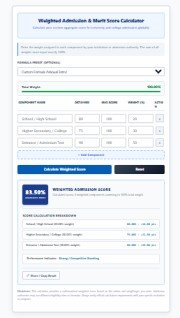
Calculate your custom aggregate score for university and college admissions globally.
WEIGHTED ADMISSION SCORE
Score Calculation Breakdown
Disclaimer: This calculator provides a mathematical weighted score based on the values and weightages you enter. Admission authorities may use different eligibility rules or formulas. Always verify official calculation requirements with your specific institution or program.
Choosing the right way to calculate an admission or merit score can be confusing when an institution gives different weightages to different components. A simple average is not always the correct method when one score contributes more than another.
Our Weighted Admission & Merit Score Calculator lets you enter your own components, scores, maximum marks, and weight percentages to calculate a custom weighted score. You can use it for an admission formula, merit calculation, academic evaluation, entrance-test weighting, or another scoring system where the component weights are known.
The calculator is intentionally flexible rather than tied to one university or country. Different institutions can use different admission formulas, so you should always enter the weightages specified by the relevant institution or admission authority.
Important: This calculator performs a mathematical weighted-score calculation. It does not determine official admission eligibility, merit rank, cutoff, or admission probability.
What Is a Weighted Admission Score?
A weighted admission score is an overall score calculated by giving different levels of importance to different components.
For example, an admission formula could assign:
- School marks — 20%
- Higher secondary marks — 30%
- Entrance test — 50%
In this example, the entrance test has the greatest influence on the final score because it has the highest weight.
A weighted calculation is useful when the components have different importance. Official institutions may publish their own formulas, and those formulas can vary by university, program, country, or admission cycle. For example, official and university-related calculators currently show different weighting systems for specific programs, which is why a custom calculator should not assume one universal formula.
How Does a Weighted Merit Score Work?
The calculation is based on two steps.
First, each component is converted into a percentage:
Component Percentage = (Obtained Score ÷ Maximum Score) × 100
Then the percentage is multiplied by the component’s weight.
The general formula is:
Weighted Score = Σ(Component Percentage × Weight) ÷ 100
For example, if your entrance-test percentage is 90% and its weight is 50%:
90 × 50 ÷ 100 = 45
So the entrance test contributes 45 points to the final 100-point weighted score.
The calculator performs these calculations automatically and shows the contribution of each component in the result breakdown.
Weighted Admission Score Formula
Suppose an admission system uses three components:
| Component | Obtained | Maximum | Weight |
|---|---|---|---|
| School Marks | 80 | 100 | 20% |
| College Marks | 75 | 100 | 30% |
| Entrance Test | 90 | 100 | 50% |
Step 1: Convert Each Score to a Percentage
School:
80 ÷ 100 × 100 = 80%
College:
75 ÷ 100 × 100 = 75%
Entrance Test:
90 ÷ 100 × 100 = 90%
Step 2: Apply the Weight
School:
80 × 20 ÷ 100 = 16
College:
75 × 30 ÷ 100 = 22.50
Entrance Test:
90 × 50 ÷ 100 = 45
Step 3: Add the Contributions
16 + 22.50 + 45 = 83.50
Your weighted admission score is:
83.50%
This is the type of calculation performed by the calculator.
Why Do Admission Weightages Matter?
A weight tells you how much influence a component has on the final score.
Consider two applicants with the same entrance-test score of 90%.
If the test has a 20% weight, its contribution is:
90 × 20 ÷ 100 = 18 points
If the test has a 60% weight, its contribution is:
90 × 60 ÷ 100 = 54 points
The underlying test percentage is identical, but its effect on the final score is very different.
This is why knowing the correct admission weightage is more important than simply entering your raw marks into a basic average calculator.
Weighted Average vs Simple Average
A simple average treats every score equally.
Suppose your three component percentages are:
- 80%
- 70%
- 90%
A simple average is:
(80 + 70 + 90) ÷ 3 = 80%
Now suppose the components have these weights:
- 20%
- 30%
- 50%
The weighted calculation becomes:
80 × 20 ÷ 100 = 16
70 × 30 ÷ 100 = 21
90 × 50 ÷ 100 = 45
Final score:
16 + 21 + 45 = 82%
So:
Simple average = 80%
Weighted score = 82%
The difference occurs because the third component has a higher weight.
Why Different Maximum Scores Matter
Admission components do not always use the same maximum score.
For example:
- Academic examination: 850/1000
- Entrance test: 135/150
- Interview: 42/50
You should not simply combine the raw numbers because the maximum scores are different.
Instead, each component should first be converted to a percentage.
For example:
850 ÷ 1000 × 100 = 85%
135 ÷ 150 × 100 = 90%
42 ÷ 50 × 100 = 84%
The calculator handles this conversion automatically before applying the assigned weight.
How to Use the Weighted Admission & Merit Score Calculator
Using the calculator takes only a few steps.
Step 1: Choose a Formula Preset
The calculator provides example presets to help you get started.
You can choose:
- Custom Formula
- Standard 3-Tier Example
- Equal Split Example
- Entrance Exam Heavy Example
These presets are examples, not universal admission formulas.
If your institution provides its own weightage, use Custom Formula.
Step 2: Enter the Component Name
Enter the name of the component you are calculating.
For example:
- High School
- Higher Secondary
- GPA
- Entrance Test
- Admission Test
- Interview
- Aptitude Test
- Academic Score
You can add your own components using the Add Component button.
Step 3: Enter Your Obtained Score
Enter the marks or score you received.
For example:
Obtained Score = 450
Step 4: Enter the Maximum Score
Enter the maximum possible score.
For example:
Maximum Score = 500
The calculator uses these two values to calculate the component percentage.
Step 5: Enter the Weight
Enter the weight assigned to that component.
For example:
Weight = 30%
The weight represents how much that component contributes to the final score.
Step 6: Check the Total Weight
The calculator continuously displays the total weight.
All component weights must add up to:
100%
For example:
20% + 30% + 50% = 100%
If the total is 90% or 110%, the formula is incomplete or invalid for this calculator.
Step 7: Calculate Your Weighted Score
Click Calculate Weighted Score.
The calculator displays:
- Final weighted score
- Number of components
- Individual component percentages
- Component weights
- Weighted contribution
- Performance indicator
This makes it easier to check how the final number was calculated.
Example: Calculate a Weighted Merit Score
Let’s use a more realistic example.
Suppose your admission formula contains:
| Component | Obtained | Maximum | Weight |
|---|---|---|---|
| Academic Marks | 850 | 1000 | 30% |
| College Result | 720 | 800 | 30% |
| Entrance Test | 135 | 150 | 40% |
Academic Marks
850 ÷ 1000 × 100 = 85%
Contribution:
85 × 30 ÷ 100 = 25.50
College Result
720 ÷ 800 × 100 = 90%
Contribution:
90 × 30 ÷ 100 = 27
Entrance Test
135 ÷ 150 × 100 = 90%
Contribution:
90 × 40 ÷ 100 = 36
Final Weighted Score
25.50 + 27 + 36 = 88.50%
Therefore:
Weighted Admission Score = 88.50%
What Can You Use This Calculator For?
Because the calculator allows custom components and weights, it can be used for many different weighted scoring systems.
Possible examples include:
- Admission merit calculations
- College admission scores
- University admission calculations
- Entrance-test weighting
- Academic performance calculations
- Scholarship scoring systems
- Custom merit formulas
- Weighted academic scores
- Application scoring systems
- Other percentage-based weighted evaluations
The important requirement is that you know the correct formula and weightage.
Can I Use This Calculator for Indian Admissions?
Yes, if you have the applicable admission weightage.
Indian universities and colleges can use different admission criteria. One institution may consider school marks and an entrance examination, while another may use a different combination of academic performance, entrance scores, interviews, or other criteria.
Therefore, there is no single universal Indian admission formula that should be assumed for every institution.
If your admission authority provides a formula such as:
Academic Score = 40%
Entrance Test = 60%
you can enter those weights into the calculator.
Always verify the current admission notification or official institutional instructions before using a calculated score for an application.
Can I Use This Calculator for U.S. College Admissions?
You can use the calculator for a defined numerical weighting formula, but it should not be treated as a universal U.S. college admissions calculator.
U.S. colleges can evaluate applicants using different criteria, and some admissions processes include factors that cannot be represented by a simple weighted percentage.
For example, an application may consider academic records alongside essays, recommendations, activities, testing, or other information.
Therefore, this calculator is useful when you have a specific numerical formula to calculate. It does not calculate your chances of getting into a U.S. college.
Custom Admission Formula Calculator
One of the biggest advantages of this tool is its flexibility.
Instead of forcing every applicant into the same three-component formula, you can create your own calculation.
For example:
Formula A
- Academic Score — 40%
- Entrance Test — 40%
- Interview — 20%
Formula B
- High School — 20%
- Higher Secondary — 30%
- Entrance Test — 50%
Formula C
- Academic Score — 50%
- Aptitude Test — 30%
- Interview — 20%
As long as your formula requires weighted percentages that total 100%, you can enter the components manually.
What Do the Formula Presets Mean?
The calculator includes three example presets.
Standard 3-Tier Example
20% + 30% + 50%
This demonstrates a three-component weighted calculation.
Equal Split Example
33.33% + 33.33% + 33.34%
This demonstrates approximately equal weighting across three components.
Entrance Exam Heavy Example
10% + 20% + 70%
This demonstrates a formula in which the entrance test has the largest influence.
These are demonstration formulas only. They should not be presented as the official formula of a particular university.
What Happens If the Total Weight Is Not 100%?
The calculator validates the total weight before calculating.
Suppose you enter:
- Academic Score — 20%
- College Score — 30%
- Test Score — 40%
The total is:
90%
The calculator will not treat 90% as though it were automatically 100%.
This is important because silently normalizing the weights could change the formula you intended to use.
You should instead check the official formula and enter the missing or corrected weight.
Understanding Your Score Breakdown
The result section provides more than just one final percentage.
It shows the contribution of each component.
For example:
Academic Score — 30% weight
85% → +25.50 points
This tells you:
- Your component percentage was 85%.
- Its assigned weight was 30%.
- It contributed 25.50 points to the final score.
This makes the calculation easier to verify manually.
Weighted Merit Score Does Not Mean Merit Rank
A common misunderstanding is treating a calculated merit score as the same thing as a merit rank.
They are different.
A weighted merit score is a numerical result produced from a formula.
A merit rank is an applicant’s position compared with other applicants.
For example, an institution might calculate a weighted score for every eligible applicant and then arrange applicants from highest to lowest score.
The final ranking can therefore depend on:
- Number of applicants
- Applicant scores
- Eligibility rules
- Available seats
- Tie-breaking rules
- Program-specific requirements
Your calculated score alone cannot tell you your official rank.
Common Mistakes When Calculating Weighted Admission Scores
1. Using a Simple Average
A simple average may be wrong when components have different weights.
2. Adding Raw Marks
Raw scores from examinations with different maximum marks should not normally be added directly.
3. Entering the Wrong Maximum Score
If the maximum score is incorrect, the component percentage will also be incorrect.
4. Using the Wrong Weightage
Always use the weightage specified by the relevant institution or authority.
5. Forgetting That Weights Must Total 100%
Check the total before calculating.
6. Confusing Score With Rank
A weighted score does not automatically represent your merit position.
7. Assuming One University’s Formula Applies Everywhere
Admission formulas can differ by institution, program, and admission cycle.
How to Get a More Reliable Result
Before using the calculator for an actual application:
Check the official admission instructions.
Then confirm:
- Which components are included.
- The maximum score for each component.
- The weight assigned to each component.
- Whether any bonus or deduction applies.
- Whether scores need normalization or conversion.
- Whether the formula applies to your specific program.
- Whether the formula is current for the relevant admission cycle.
Once you have confirmed these details, enter them into the calculator.
Weighted Admission Score vs Weighted Average
The concepts are closely related, but they are not always used in exactly the same context.
A weighted average generally combines values according to their assigned weights. For example, academic results can be weighted according to credit values or other institutional rules. Some universities provide their own weighted-average calculators for evaluating academic records.
A weighted admission score applies the same mathematical idea to an admission or merit formula.
The important point is to use the exact weighting system required for the calculation you are performing.
Frequently Asked Questions
What is a weighted admission score calculator?
A weighted admission score calculator calculates an overall score from multiple components after applying a specified weight to each component.
How do I calculate my admission merit score?
Convert each component into a percentage, multiply each percentage by its assigned weight, and add the resulting contributions.
Weighted Score = Σ(Percentage × Weight) ÷ 100
What is a weighted merit calculator?
A weighted merit calculator is a tool that calculates a merit or aggregate score when different components have different levels of importance.
Why do admission weights matter?
Weights determine how strongly each component affects the final result. A component with a 50% weight has more influence than one with a 10% weight.
Do all weights need to equal 100%?
For this calculator, yes. The component weights must total exactly 100%.
Can I add my own components?
Yes. You can add components, enter their names, scores, maximum marks, and weights, and remove components when necessary.
Can I use different maximum scores?
Yes. Each component can have its own maximum score. The calculator converts each component to a percentage before applying the weight.
Can I use this for university admission?
Yes, when you know the numerical admission formula specified by your institution or program.
Can I use it for Indian college admissions?
Yes, for custom weighted calculations. However, Indian institutions can use different formulas, so verify the current official admission requirements first.
Can I use it for U.S. college admissions?
Yes, for a specific numerical weighted formula. It should not be used to predict admission chances because U.S. admissions may consider factors beyond a numerical weighted score.
Does this calculator calculate my admission chances?
No. It calculates a weighted score from the information you enter. It does not predict whether you will be admitted.
Does it calculate merit rank?
No. A merit rank requires comparison with other applicants and the institution’s official ranking process.
What happens if my weightage is 90%?
The calculator requires the total weight to equal 100%, so you should check the admission formula and correct the component weights before calculating.
Is the result an official admission score?
No. The result is a mathematical calculation based on your inputs. The relevant institution or admission authority determines the official score and eligibility rules.
Related Calculators
If you are checking your academic results before calculating a weighted admission score, you may also find our CGPA to Percentage Calculator useful for converting CGPA into percentage.
If you are monitoring attendance requirements during your studies, use our Attendance Percentage Calculator to calculate your current attendance and target attendance.
For students who want to check attendance separately for different subjects, our Subject Wise Attendance Calculator can help calculate each subject’s attendance individually.
These tools can be useful alongside a weighted admission score calculator when planning your academic performance.
Final Thoughts
Calculating a weighted admission or merit score does not have to involve complicated spreadsheets.
The Weighted Admission & Merit Score Calculator allows you to enter your own components, obtained scores, maximum scores, and weightages. It then converts each component into a percentage, applies the assigned weight, and provides a final weighted score with a detailed contribution breakdown.
The most important part is using the correct formula.
If your university, college, school, or admission authority publishes a specific weighting system, use those values rather than relying on a generic formula.
For example, a formula might give an entrance test 50% of the final score while academic marks contribute 30% and an interview contributes 20%. The calculator can reproduce that mathematical weighting once those values are entered.
Whether you’re checking an admission formula in India, the United States, or another country, remember that admission rules can vary considerably. The calculator helps you perform the mathematics; it does not replace the official admission requirements.
Always verify the final formula, eligibility requirements, and admission decision with the relevant institution or admission authority.